
Loren D'Souza, Author at ECA Internships - Page 14 of 14  
Linkedin Tips to Do Today

Linkedin Tips to Do Today

2,235 Views

There are more than 350 million professionals on LinkedIn. I’m going to share with you my best tips to stand out!

Before we get into tips & tricks, let’s review some statistics…

  • Over 500 million users worldwide
  • 4.2 million Australian users
  • 40% of users log on daily
  • 2 new users every second
  • 40 million users are students or recent grads
  • 41% of millionaires use LinkedIn
  • Currently over 3 million job postings on Linked ‘In
  • 18x more likely to be seen by recruiters if your profile is updated

LinkedIn has revolutionized the way that we search and apply for jobs as well as connect and collaborate with other professionals. Considering this, I want to make sure that you create a great LinkedIn profile that will help you stand out and accomplish your goals. let’s take advantage of all that LinkedIn has to offer!

Put in the time to make it awesome…

The headline is the most important aspect of the profile! Be succinct, creative, and include relevant terms that make it easy for others to define your industry and your role within.

This is where you really sell yourself to potential connections, your summary is prime real estate for your professional brand. It should expand on what appears in your headline, highlighting your specialties and career experience.

The good news? LinkedIn will measure the “completeness” of your profile as you work and offer suggestions on how to make it stronger. The more complete your profile, the better the odds that the recruiter will find you in the first place.

Extra Tips:

  • LinkedIn users who update their profiles regularly get more job offers.

What should your LinkedIn profile picture look like?

First impression matter during business meetings and when people see your profile picture. As yourself what does your LinkedIn profile picture say about you? Consider your industry in addition to potential consumers and peers to select the appropriate headshot.

Typically, I would recommend having a professional photographer take your headshot.

However, if you don’t have the budget, here are 6 tips to help you pick a strong photo from the ones you already have:

  • Choose a photo that looks like you
  • Make sure your face takes up at least 60% of the frame.
  • Choose the right expression, look friendly
  • Wear what you’d wear to work.
  • Don’t over edit your picture
  • Choose a background that isn’t distracting.

Extra Tips:
Adding a professional picture of yourself on your LinkedIn profile can result in 14 Times more profile views.

#Nofilter

Stay active!

Don’t disappear for months at a time. Stay active and keep posting things in your feed to stay relevant.

Another point that I want to make is to be professional. LinkedIn is a social networking site for professionals. Be sure to conduct yourself and create your profile to reflect this.

Keep your profile up to date. As you acquire new skills, take on new jobs, and accomplish new things, be sure to update your LinkedIn profile, which should be an ever-evolving document.

Extra Tips:
Your Profile is 5 Times more likely to be viewed if you join and are active in groups.
Be visible…

LinkedIn is a great place to get updates, ideas, and resources from industry leaders, but make sure to create a win-win relationship in which you’re also sharing your knowledge and helping people in your network.

Publishing posts is a great way to showcase your professional knowledge, position yourself as a thought leader in your industry.

Extra Tips:
20 LinkedIn posts per month can help you reach 60% of your unique audience.
The best times to post on LinkedIn Tuesday and Thursday, between 7 am and 9 am local time.

Endorse the people you respect

Endorsements can be a great way to show off your skills, in consideration that your profile isn’t overloaded with too many to really send the right message.

Endorsements work differently than recommendations. Anyone can visit your profile, read your skills list, and hit the “endorse” button for the skills they know you have.

The secret to making them work for you is keeping your skills updated. As you transition between careers, develop new skill, or take on new responsibilities, drop outdated skills from your profile and add the ones you really want to be known for. Now, when connections land on your page, they’ll only see the most relevant skills.

Extra Tips:

 One of the best ways to get endorsements on LinkedIn is to endorse others.

 Send a thank you message when someone endorses you.

Show Your achievements

To determine what is relevant to showcase you need to start with understanding what your intention is with LinkedIn and who you want to attract to your profile.

Your unique career path is a big part of who you are today. That’s why being able to showcase your individual professional journey on LinkedIn is a great way to help you stand out to potential new connections, customers, and recruiters.

Recruiters spend countless hours scouring LinkedIn in search of the high performers. And when they find them, they contact said high performers. Knowing this, you’ll serve yourself well to market yourself as a high performer in your summary and experience section. Think action words, accomplishments, talking about times you’ve been promoted or hand-picked for projects.

Extra tips:
Show off your skills, to gain post visibility use relevant hashtags! #success #project #accomplishment

It’s time to share and expand your network!

Once you’ve created an excellent profile on LinkedIn, share it with pride. Share the URL to your LinkedIn profile on your business card, e-mail signature, and in other places to help build your network. Add people you meet through networking events or at work and stay in touch.

Enjoy LinkedIn(ing)!

Click here to send in an enquiry and get connected with internship opportunities from businesses across Australia.

How to write a professional email? | A Quick Guide

How to write a professional email? | A Quick Guide

3,652 Views

Writing a professional email may seem like a simple task, but it’s not something that should be taken lightly. In many cases, receiving an email from you may be the very first impression that you make on a potential employer. That’s why it’s important to treat it as part of the interview process and take it seriously. Even if you’re already in the workplace, knowing how to craft a professional email can benefit your relationships with co-workers and clients, and improve your professional reputation. So, how can you find out if your emails are suitable? ECA Internships has got you covered! Here’s a quick list of tips to help you out… For the job seeker:

  • Carefully consider every email you send to a potential employer as part of the interview process. The employer will judge whether or not you know how to conduct yourself as a professional based on how you present yourself.
  • Don’t tell your life story. You’re asking for a job, not pitching a novel. Keep all information relevant. If the employer would like more information about you, they will request it.

If the job ad asks for any specific information or documents, make sure you provide them in the email. Additionally, make sure documents are named as something appropriate. Resumes should be labelled as “Resume” or “John Smith – Resume” instead of “Johnny’s resume” or anything else. If they ask for specific documents, such as your resume or a copy of your qualifications, and you neglect to include them, you are showing them that you don’t follow instructions very well, which is not a good first impression.

When writing to a manager or co-worker:

  • Write as if you are speaking to them. If you have a casual, friendly rapport with that person, it’s ok to write in a more casual manner. However, if you have a very formal, professional rapport with the person, then make sure your email communication reflects that.
  • Try to be as helpful as you can. If you can’t help, explain why or redirect them to someone who can. If you would like to help, but are simply too busy, it’s ok to explain that in a professional way.
  • If you’ve made a mistake, take responsibility and apologise. Do everything you can to make it right.
  • Never discuss personal information using your professional email. If you want to discuss matters unrelated to work with a co-worker, it’s best to establish another method of communication, such as exchanging mobile numbers or personal email addresses or becoming friends on Facebook.

When writing to a client:

  • Always use your company’s approved signature. Most companies will encourage this to assist with branding.
  • Take their requests seriously. If you can’t assist, explain why or direct them to an alternative contact or resource. You never want to seem unhelpful or uncooperative.
  • Remember that you represent your company when you email external clients. Their interactions with you may affect whether or not they continue to do business with your firm and how they talk about your company to their colleagues. Think of each email to a client as a business meeting.
  • Do not overwhelm clients with emails. Try to combine all info into as few emails as possible, as it’s more efficient and easier for the client to refer to later. Clients could become annoyed if they feel as if you’re pestering them all the time with endless emails.

For everyone:

  • Be respectful! Even if the person you’re corresponding with hasn’t been respectful to you, it’s important that you keep your emails professional.
  • Don’t be overly casual unless you truly have a rapport with the person. If you try to force it, this can be interpreted as disrespectful.
  • Remember that emails are a written record. This means that anyone you correspond with could forward your message to someone else. You never really know who will see your emails, so make sure all content is appropriate. Additionally, if you’re using your employer’s email server, chances are your employer can also access and search your emails. Keep that in mind when deciding what to write in an email. Never complain or being overly negative in your email communications, and most definitely never be insulting!
  • Emails are not texts! When crafting a professional email, whether it’s for a potential new employer, client, co-worker, or your boss, the message should be written in complete sentences and free of emojis and shorthand.
  • Begin with a friendly opening.
  • Consider how you would like your email answered. If you’d like a polite response, make sure your tone is polite. If you need a reply fairly urgently, make sure you inform the person that the matter is urgent. If you want or need more information, make sure that you clearly ask for it.
  • Use a classic, easy-to-read font.

In my own experience from hiring people for my department, I know that first impressions from emails can greatly impact my decision on whether or not to call someone for an interview. You want to give yourself every possible advantage, so why risk ruining what could be a great opportunity by throwing together a poorly prepared introductory email?

Here is the basic structure of a professional email:

  • Greeting
  • Opening
  • Body
  • Salutation
  • Signature

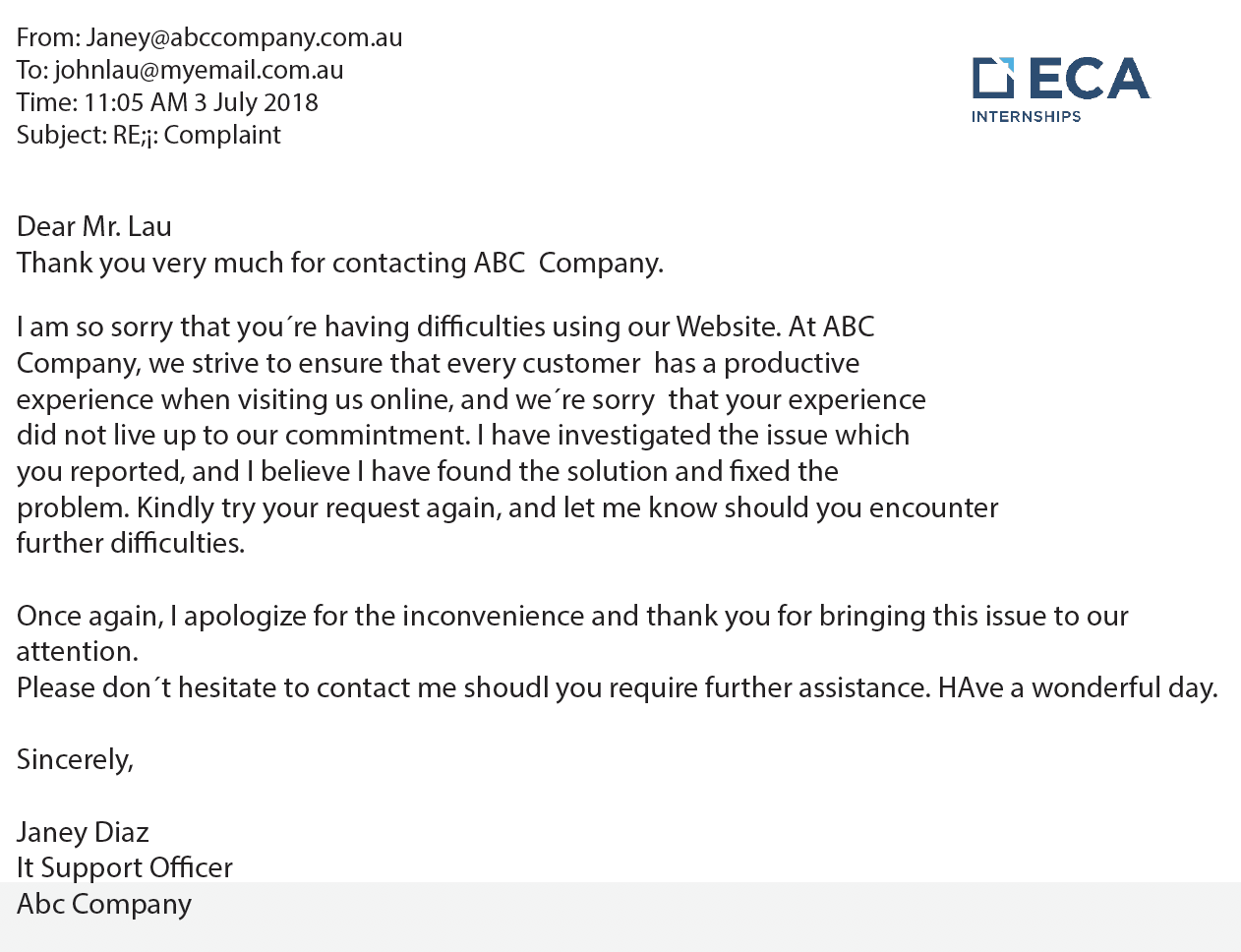
Let’s check out these examples: Good:

  • Professional
  • Acknowledges a request that’s been made and explaining politely why the writer can’t accommodate
  • The writer does not actually say no, but explains their reasoning and welcomes further discussion
  • Proper structure and style
  • Thanks the reader

  • Polite and calm tone
  • Proper style and structure
  • Apologises for inconvenience
  • Thanks the customer for the comment
  • Addresses and resolves the concern
  • Represents the company in a professional manner

Bad

What to Expect From an Accounting or Finance Internship Interview

What to Expect From an Accounting or Finance Internship Interview

2,308 Views

So, you’re a fresh graduate in the field of accounting and finance and you’d like to get some experience to put on your resume and grow your professional network? That’s great! An internship can be a great place to start. But, what should you expect if you’ve never attended an interview before? And, how can you prepare? We’ve got you covered! We asked Marlene Raddino, Training Manager at New Direction Training, who takes accounting interns regularly, and here’s what she says:

“I don’t focus as much on the accounting questions, actually. I can get a basic idea from their resume. They could be an excellent, advanced student, but if they have a poor attitude, then they won’t learn much. For interns, I’m far more interested in their willingness to learn from the team.”

Marlene also said she asks these questions in nearly every interview:

  • Can you identify your strengths and weaknesses?
  • How do you work in a team?
  • Have you ever worked in an office environment before? How did you find it?
  • What’s your workflow like? How do you manage it?

How do you feel about asking for help when you don’t know something?

Marlene also asks about different scenarios that might come up in the office, such as what you might do if you realised you made a mistake or had to deal with a difficult customer, how you relate to coworkers, etc.

What we hear more and more from employers, is that interviews are largely behavioural. The employer wants to see that you can conduct yourself as a professional, process information easily, have a good work ethic, and that you will fit in with their team. While it’s important to present yourself as a professional, make sure you can back up your technical skills described on your resume as well, and make it clear that you’re willing to learn!

Some common ways employers will assess your technical skills are:

Employment assessments (in some cases sent via email prior to the interview). These could be tests to determine how well you know how to use programs such as Excel or Xero.
Skills assessments at the interview. Some of our clients have candidates take an accounting knowledge test.
✓ Questions about your accounting coursework or background

Check out our other articles to find more ways to prepare yourself for your interview and more as part of our job readiness series!

To check out the latest internship opportunities in accounting & finance click here.

Click here to send in an enquiry and get connected with internship opportunities from businesses across Australia.

APPLY NOW